

Key Takeaways
- Wet food delivers significantly more moisture, which supports urinary tract health in cats and dogs.
- Raw diets carry real food safety risks, including bacterial contamination that can affect both pets and people.
- Dry kibble is the most calorie-dense format per dollar, but protein quality varies widely by formula.
- No single format is universally superior; the right choice depends on species, health status, and life stage.
- Transitioning between formats should be done gradually to avoid digestive upset.
Our Verdict
Wet food suits pets with urinary concerns or low thirst drive. Dry kibble works well for healthy adults where cost and convenience matter. Raw feeding requires rigorous food-safety practices and veterinary guidance, and is not appropriate for all households or all pets. Most pets do well on a single well-balanced format chosen to match their specific health needs.
| Best for | Recommended |
|---|---|
| Cats prone to urinary or kidney issues | Wet food |
| Budget-conscious owners feeding healthy adult dogs | Dry kibble |
| Owners with time, freezer space, and veterinary support | Raw diet |
| Pets needing palatability support or appetite stimulation | Wet food |
How the three formats differ at a glance
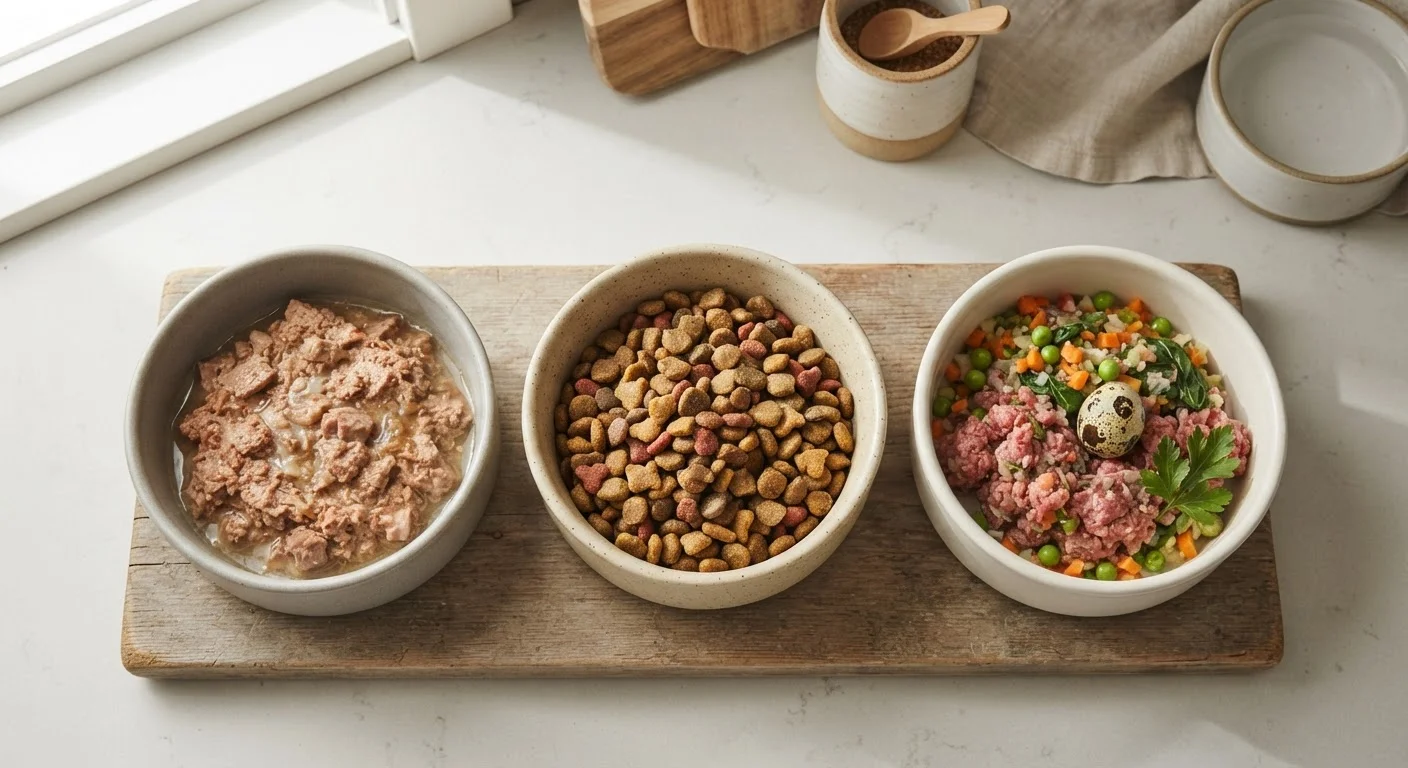
Wet food, dry kibble, and raw diets are not simply different packaging for the same nutrition. They differ in moisture content, protein bioavailability, processing methods, and the practical demands they place on owners. Understanding those differences is the foundation for any feeding decision. If you are new to thinking about pet nutrition at all, this plain-language introduction covers the core concepts first.
| Wet food | Dry kibble | Raw diet | |
|---|---|---|---|
| Moisture content | 70-80% | ~10% | 60-70% |
| Protein digestibility | Moderate to high | Moderate (varies by formula) | Generally high |
| Food safety risk | Low | Very low | Higher (bacterial contamination) |
| Shelf life (opened) | 1-3 days refrigerated | Weeks to months sealed | 1-2 days refrigerated after thawing |
| Cost per serving | Moderate to high | Low to moderate | High |
| Preparation effort | Minimal | Minimal | Significant |
The table above captures the broad picture, but each category deserves a closer look.
Moisture content and why it matters
Wet food contains roughly 70 to 80 percent water. Dry kibble sits at about 10 percent. Raw diets, depending on formulation, typically fall between 60 and 70 percent moisture. That gap has real consequences, particularly for cats, who evolved as desert animals with a weak thirst drive and rely heavily on food moisture to meet their daily water intake.
For dogs with kidney disease or a history of urinary crystals, veterinarians often recommend increasing dietary moisture as part of a broader management plan. Wet food accomplishes this without requiring the pet to drink more water voluntarily. Cats have several nutrients they cannot synthesize on their own, and adequate hydration supports the kidneys that process those nutrients. Dry kibble alone may leave some cats chronically under-hydrated, though water fountains and wet-food supplements can partially offset this.
Protein quality across formats
All three formats can supply adequate protein, but the source and processing method affect how usable that protein is. High-heat extrusion, used to make dry kibble, can reduce the digestibility of some amino acids. Wet food is processed at lower temperatures in most cases, and raw diets are uncooked, which preserves heat-sensitive nutrients.
Protein quality depends more on the ingredient list than the format itself. A kibble with named meat as its first ingredient and a clear amino acid profile can outperform a wet food built around meat by-products and fillers. Reading the guaranteed analysis and the ingredient order matters more than assuming one format is inherently superior.
For dogs specifically, the grain-free trend introduced complexity here. Research into grain-free dog diets has raised questions about cardiac health that remain active in veterinary literature, and protein source alone does not determine a diet's safety.
Food safety and raw diets
Raw diets warrant a separate discussion on safety. The American Veterinary Medical Association and the U.S. Food and Drug Administration have both published statements noting that raw meat-based diets carry risk of contamination from pathogens such as Salmonella, Listeria, and Campylobacter. These organisms can sicken both pets and the humans handling their food and bowls.
This risk is not theoretical. It is why raw feeding requires strict food-handling protocols: dedicated cutting boards, prompt refrigeration, thorough handwashing, and keeping raw food away from other kitchen surfaces. Immunocompromised people, young children, and elderly household members face greater exposure risk. A detailed look at raw diets for dogs separates common claims from what food-safety research actually shows.
Raw feeding and household safety
Raw meat-based pet diets can harbor pathogens that spread through contact with food, bowls, and prep surfaces. Households with immunocompromised individuals, infants, or elderly members face higher risk of secondary infection. Always wash hands thoroughly after handling raw pet food, and sanitize all surfaces and utensils promptly.
Commercially prepared raw diets that are high-pressure processed (HPP) reduce but do not eliminate pathogen risk. Any household considering raw feeding should discuss the decision with a veterinarian before starting.
Cost and practical considerations
Dry kibble costs less per calorie than wet food in almost every comparison. A 30-pound bag of kibble typically provides far more meals than the equivalent spend on canned food. Raw diets, whether commercial or home-prepared, are generally the most expensive option and require freezer space and consistent sourcing.
Wet food has a shorter open-can shelf life, usually one to three days refrigerated. Kibble stays shelf-stable for months if stored in a cool, dry location in a sealed container. Raw food must remain frozen until use and thawed safely in the refrigerator rather than at room temperature.
For owners feeding multiple pets or working within a tight budget, kibble often wins on practicality. A side-by-side comparison of dry and wet dog food across cost and convenience goes deeper on these tradeoffs for dog owners specifically. Regardless of which format you choose, transitioning gradually reduces the chance of digestive upset when changing formats or formulas.
This article is for informational purposes only and is not a substitute for veterinary dietary advice tailored to your individual pet.