

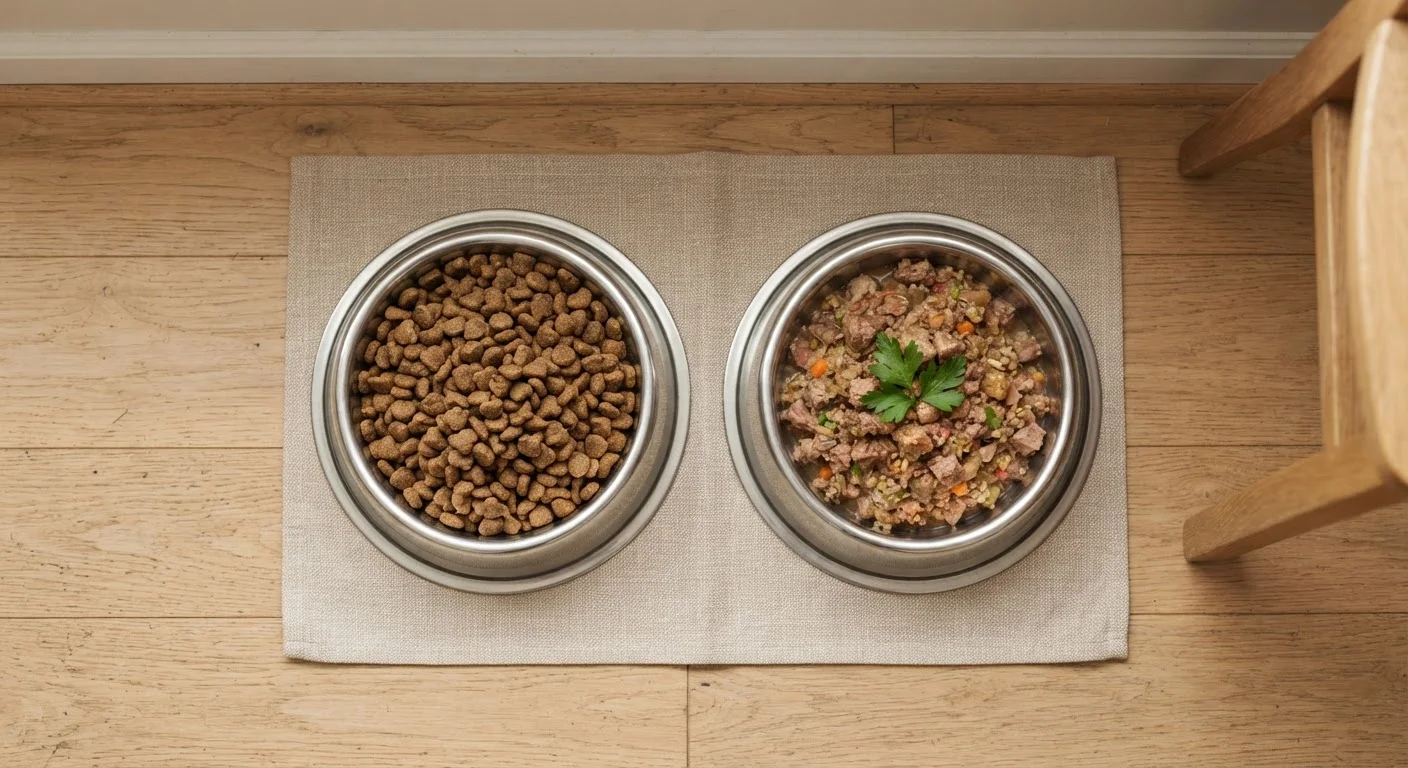
Key Takeaways
- Dry kibble costs less per serving and keeps well without refrigeration after opening.
- Wet food has significantly higher moisture content, which can support hydration in some dogs.
- Neither format is nutritionally superior when both meet AAFCO nutritional standards.
- Mixing dry and wet food is a common and generally safe approach for most healthy dogs.
- A dog's age, health conditions, and chewing ability should guide format choices.
- Always consult a veterinarian before making major changes to your dog's diet.
Option A
Dry kibble
The convenient, budget-friendly everyday staple.
Best for: Owners who want an affordable, shelf-stable food that supports dental health and easy portion control.
Option B
Wet food
The moisture-rich, palatable option for picky or aging dogs.
Best for: Dogs with low thirst drive, dental problems, or difficulty chewing, and owners who prioritize palatability.
If you are feeding a healthy adult dog on a budget
Dry kibble
Kibble costs less per daily serving, stores easily, and provides consistent nutrition when you choose a product that meets AAFCO standards.
If your dog is a picky eater or has a low thirst drive
Wet food
Wet food's stronger aroma and high moisture content can encourage intake in dogs that resist eating or drink very little water.
If your dog is a senior with worn or missing teeth
Wet food
Soft wet food is easier to chew and swallow, reducing discomfort for dogs whose dental health has declined with age.
If you want the benefits of both formats
Dry kibble
Use kibble as the base and add a small amount of wet food for palatability. This keeps costs manageable while improving your dog's mealtime experience.
What sets these two formats apart
Dry kibble and wet food differ most fundamentally in water content. Kibble typically contains around 10 percent moisture, while wet food commonly ranges from 70 to 80 percent. That gap affects caloric density, shelf life, texture, and how much food your dog needs per meal.
Kibble is made by mixing proteins, carbohydrates, fats, vitamins, and minerals, then cooking and extruding the mixture into small pieces. Wet food is generally a blend of meat, broth, and other ingredients sealed in a can or pouch. Both can be nutritionally complete when formulated to meet standards set by the Association of American Feed Control Officials (AAFCO). The AAFCO statement on a package label is the clearest indicator that a food is appropriate for your dog's life stage.
For a broader look at how food formats compare on protein quality, safety, and cost, see the side-by-side nutrition breakdown in the Pet Nutrition Guide.
Nutrition, hydration, and dental health
On a dry-matter basis (meaning once water is removed from the comparison), a well-formulated kibble and a well-formulated wet food can deliver comparable protein, fat, and micronutrient levels. The practical difference is in how much food you scoop. Because wet food is so water-heavy, the same weight delivers fewer calories than kibble, so serving sizes are larger and costs per calorie tend to be higher.
Hydration is one area where wet food has a real edge. Dogs that drink little water on their own, or those prone to urinary issues, may benefit from the added moisture in wet food. That said, wet food is not a substitute for fresh water being available at all times.
Dental health is more nuanced. Dry kibble is sometimes said to clean teeth through a scraping action during chewing, though the American Veterinary Dental College notes that this effect is modest at best. Specially formulated dental kibble with the Veterinary Oral Health Council (VOHC) seal has better evidence for plaque reduction than standard kibble. Wet food does not provide any mechanical cleaning and, if left on teeth, may contribute to plaque buildup. Regular tooth brushing matters far more than food format for oral health.
| Criterion | Dry kibble | Wet food |
|---|---|---|
| Moisture content | Around 10% | 70 to 80% |
| Cost per serving | Lower | Higher |
| Shelf life after opening | Weeks (sealed container) | 2 to 3 days (refrigerated) |
| Dental benefit | Modest at best | Minimal to none |
| Palatability | Moderate | Higher (stronger aroma) |
| Ease of portion control | Easy | Requires more care |
| Good for low-water drinkers | Less suitable | More suitable |
| Suitable for dogs with poor teeth | Depends on kibble size | Generally yes |
Cost, convenience, and storage
Dry kibble is less expensive per serving for most dog sizes. A bag stays fresh for weeks after opening when stored in a sealed container away from heat and moisture. Wet food costs more per calorie, requires refrigeration after opening, and should be used within two to three days once the can or pouch is open.
For busy households or owners who travel with their dogs, kibble is simpler to measure, pack, and serve. Wet food requires a bowl, a utensil, and a plan for leftovers. Neither format is logistically impossible, but the day-to-day effort of wet food is higher.
If you are new to thinking about your dog's nutritional needs overall, the plain-language introduction to pet nutrition covers core concepts including macronutrients and feeding schedules.
70-80%
Moisture content in wet dog food
Compared to roughly 10% in dry kibble, this difference significantly affects caloric density and daily serving sizes.
~10%
Moisture content in dry kibble
The low moisture level in kibble is what makes it shelf-stable and more calorie-dense per gram than wet food.
2-3 days
Refrigerated shelf life for open wet food
Open cans or pouches of wet food should be stored covered in the refrigerator and used within two to three days to avoid spoilage.
When to mix, when to specialize, and when to ask your vet
Many owners feed a combination: kibble as the daily base and a spoonful of wet food added for palatability or variety. This approach is practical for healthy adult dogs with no specific medical needs. When mixing, adjust total portions to avoid overfeeding since wet food adds calories.
Puppies, pregnant or nursing dogs, seniors, and dogs with health conditions such as kidney disease, diabetes, or food allergies may need a specific format or formulation. In those cases, a veterinarian's guidance matters more than a general comparison. Kidney disease, for example, often warrants higher moisture intake, which makes wet food a frequent recommendation in those situations.
If you are curious about how feeding approaches differ beyond kibble and wet food, the truth about raw diets for dogs covers what veterinary and food-safety research actually says about that option.
This article is for informational purposes only and does not constitute veterinary nutritional advice. Consult your veterinarian before making significant changes to your dog's diet.