

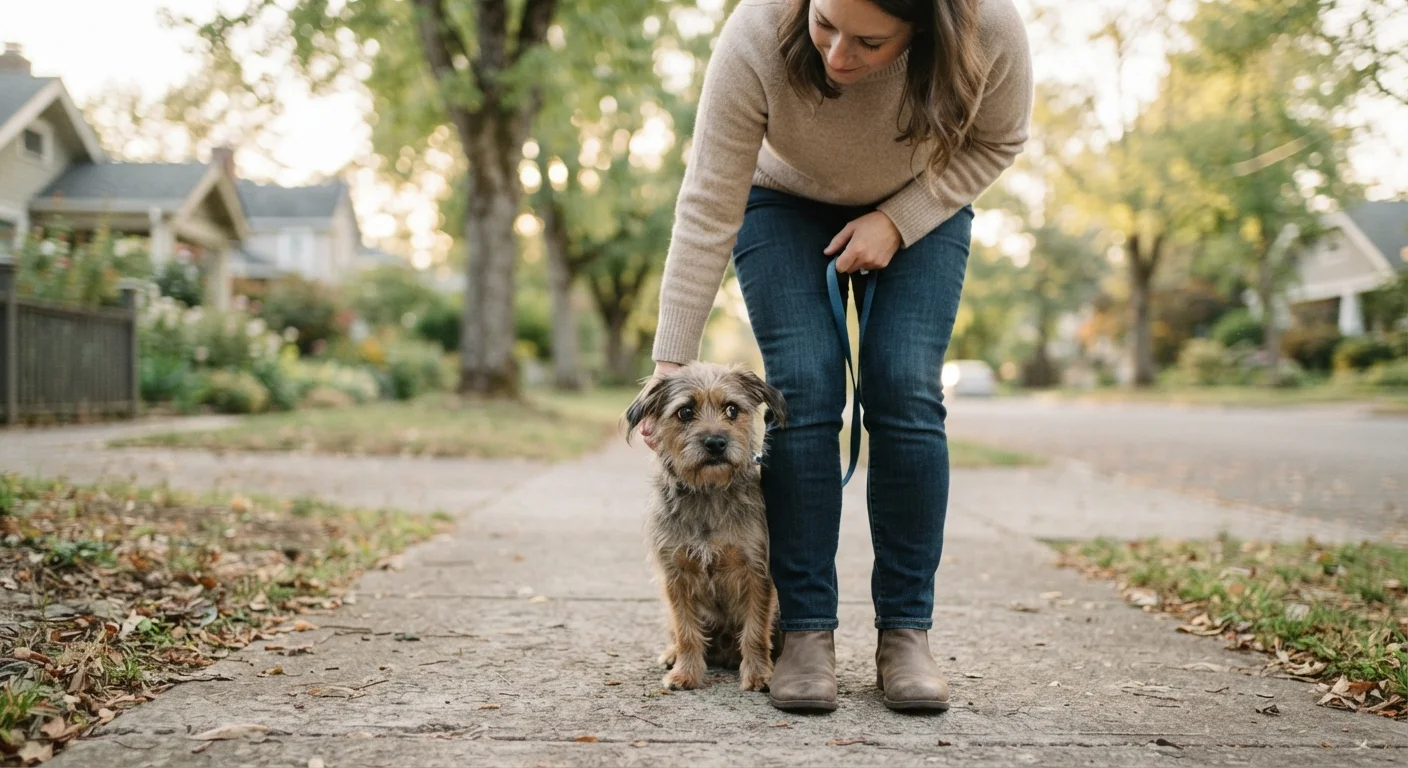
Key Takeaways
- Forced exposure makes fear worse; progress depends on letting the dog set the pace.
- Recognizing early stress signals, like lip licking and yawning, helps you intervene before a dog shuts down.
- Short, positive sessions repeated consistently build more confidence than long, infrequent ones.
- A safe home base gives a fearful dog a reliable place to decompress between exposures.
- Consulting a certified applied animal behaviorist is appropriate when fear is severe or persistent.
What you will need
Why some dogs are fearful and what that looks like
Fear in dogs has several roots: incomplete socialization during the critical window (roughly 3 to 14 weeks of age), a traumatic experience, genetic predisposition, or some combination of all three. A dog that missed varied, positive exposure to people, sounds, and environments early in life often treats novelty as a threat rather than something neutral.
Fear does not always look dramatic. Watch for these early stress signals before a dog reaches the point of cowering or fleeing:
- Lip licking or repeated yawning outside of tiredness
- Whale eye (showing the whites of the eyes)
- Tail tucked against the belly
- Body low to the ground or weight shifted back
- Sudden loss of interest in food the dog normally loves
When you see those signals, the dog is telling you the current situation is too much. Pushing past that point, by forcing the dog closer to whatever is frightening it, activates a stress response that makes future exposures harder, not easier. The goal is to keep the dog below that threshold so learning can actually occur.
If your dog shows panic even in familiar environments without obvious triggers, that pattern can overlap with separation-related distress. The separation anxiety guide covers how to tell the two apart and what to do about the latter.
Setting up the right environment before you start
A fearful dog needs at least one place in the home where it feels genuinely safe. This is not a luxury; without a reliable retreat, the dog stays in a low-grade state of alertness that slows all progress.
A covered crate works well for many dogs because it limits visual stimulation and signals a clear boundary that other household members can respect. The humane crate training approach walks through how to introduce the crate so the dog chooses to go there rather than being placed there. A dog bed in a quiet corner behind a piece of furniture can serve the same purpose if a crate is not practical.
The rule is simple: nothing frightening happens near that spot. No guests approach it, no children reach in, no other pets bother the dog there. Over time, the dog learns that retreating to that space works, which means it will use it instead of escalating to growling or snapping.
What you will need
How to introduce new people and places gradually
Systematic desensitization, paired with counter-conditioning, is the standard behavioral approach for fear. In plain terms: you expose the dog to a very mild version of the thing it fears while pairing that exposure with something it genuinely enjoys, usually a high-value food treat.
Identify the dog's specific fear triggers
Before any exposure work, make a simple list of what actually frightens your dog. Strangers? Men specifically? Hats? Traffic noise? Children? The more precisely you identify the trigger, the more targeted and effective your sessions will be. Watch for the early stress signals described above as your guide.
Find the dog's threshold distance
Threshold is the point at which the dog notices the trigger but has not yet gone into a stress response. For some dogs this is 30 feet from a stranger; for others it may be across a parking lot. Start all sessions at this distance or farther. The dog should be able to see or hear the trigger and still take a treat from your hand.
Pair the trigger with something the dog loves
The sequence is: trigger appears, high-value treat appears immediately. Trigger goes away, treats stop. Repeat this pattern in short bursts of two to five minutes. Over many repetitions, the dog's brain begins to associate the previously scary thing with something good. This is counter-conditioning at its most basic level.
Decrease distance only when the dog signals readiness
Readiness looks like the dog orienting toward the trigger without stiffening, or glancing at the trigger and then back at you with a relaxed body. Do not decrease distance on a schedule; decrease it only when the dog's body language is relaxed at the current distance across multiple sessions.
Give the dog control over social interactions
When introducing new people, ask them to crouch sideways to the dog (direct frontal approaches are threatening), avoid eye contact, and hold a treat at arm's length without reaching toward the dog. If the dog approaches and sniffs, that is the dog choosing contact. If the dog backs away, the person should not follow. Letting the dog control the pace of approach builds confidence far faster than guided contact does.
End every session before the dog gets tired or stressed
Sessions that end on a calm, successful note are more effective than longer sessions that push the dog to its limit. Five minutes of productive, below-threshold exposure repeated daily will outperform a 45-minute session that leaves the dog exhausted and more sensitized. Use the dog's body language, not a clock, to decide when to stop.
Consistency across sessions matters more than the length of any single session. A structured daily routine makes it easier to fit in short socialization windows without the dog being overstimulated by the rest of the day.
When to get professional help
Some dogs make steady progress with patient, consistent owner-led work. Others have fear that is severe enough that owner efforts alone plateau or accidentally make things worse. Signs that professional support is appropriate include aggression (lunging, snapping, biting) triggered by fear, no measurable progress after four to six weeks of consistent work, and fear that is affecting the dog's basic daily functions like eating or toileting normally.
A certified applied animal behaviorist (CAAB) or a veterinary behaviorist can assess whether the dog's fear has a physiological component and whether behavior medication might help lower the dog's baseline anxiety enough for training to take hold. Medication alone does not teach a dog new responses, but it can make the dog accessible to learning in ways that were not possible before.
Avoid trainers who rely on flooding (sustained forced exposure) or punishment-based techniques with fearful dogs. These methods suppress visible fear signals without addressing the underlying emotional state, which makes behavior harder to predict and the dog less safe over time.
This article is for informational purposes only and does not constitute veterinary or professional behavioral advice. Consult a qualified veterinarian or certified animal behaviorist for guidance specific to your dog.