

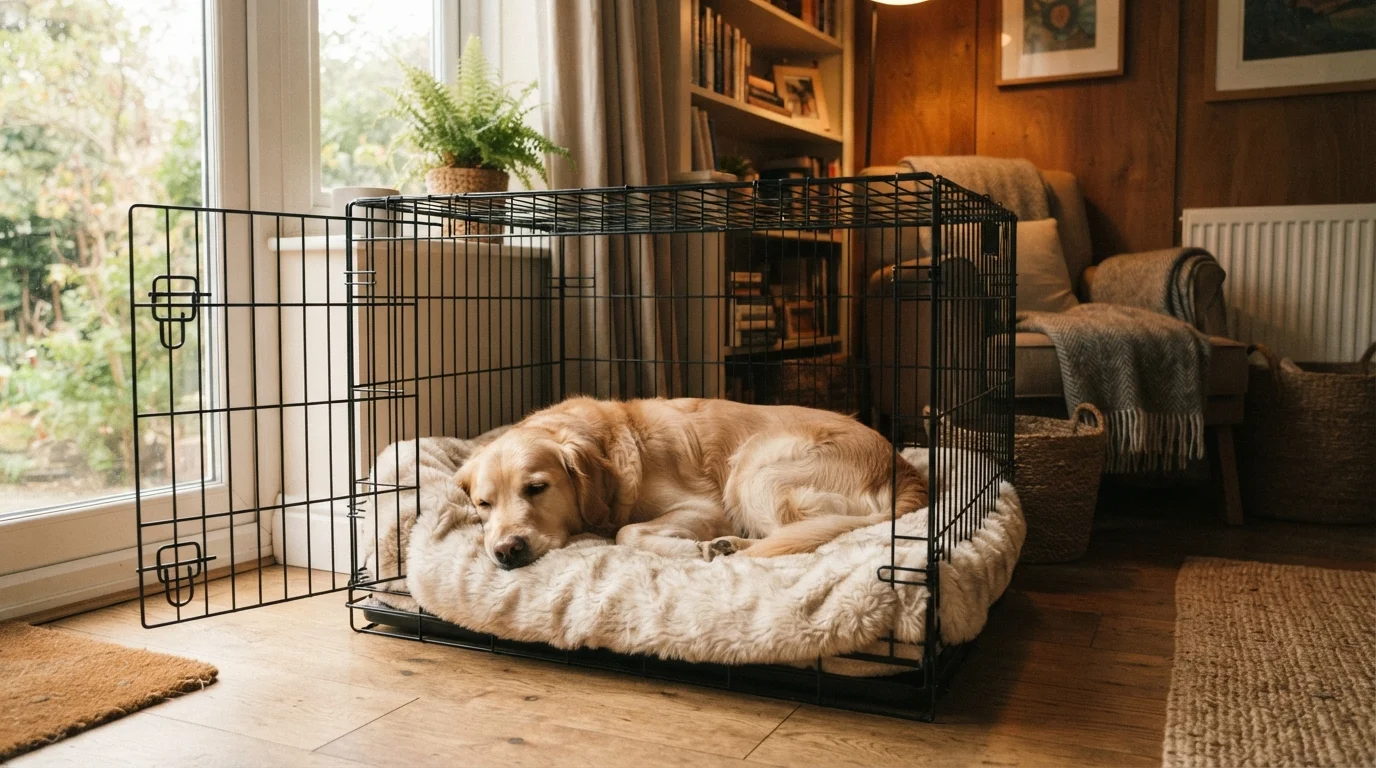
Key Takeaways
- Crate training works best when the dog associates the crate with positive experiences, not confinement.
- Rushing the introduction is the most common reason dogs resist or fear their crates.
- Most dogs become comfortable with a crate within one to three weeks when the process is gradual.
- The crate should never be used as punishment.
- Puppies under six months need bathroom breaks every two to three hours and cannot stay crated all day.
What you will need
Why crate training is worth doing
A crate gives a dog a predictable, enclosed space it can call its own. Dogs are den animals by nature, and many settle more easily when they have a defined retreat. A well-introduced crate also makes travel safer, simplifies housetraining, and gives you a reliable way to keep a dog out of trouble during unsupervised moments.
The word "crate" carries a bad reputation mainly because of how it gets misused. Dogs that spend excessive hours inside, or that are locked in as a punishment, do develop negative associations. But a crate used with reasonable time limits and a patient introduction rarely causes that outcome. The goal is a dog that walks into the crate on its own, settles down, and rests without distress.
If your dog shows fearful or avoidant behavior around any new space or confinement situation, pair this process with the advice in our guide to building confidence in shy or fearful dogs.
What you will need
Step-by-step crate introduction
Work through these steps in order. Do not advance to the next step until your dog is relaxed and shows no signs of stress at the current one. Signs of stress include panting, yawning repeatedly, lip licking, trying to exit, or refusing treats.
Place the crate and let the dog investigate
Set the crate in a low-traffic area of a room where the family spends time. Leave the door open or remove it entirely. Put a blanket inside and let your dog sniff around the crate freely. Do not push the dog inside or lure it in yet. Some dogs walk in on their own within minutes; others take a full day to approach.
Lure the dog to the entrance with treats
Once your dog is comfortable approaching the crate, hold a treat near the entrance and let the dog take it. Repeat several times. Then hold the treat just inside the opening so the dog has to put its nose or one paw in to reach it. Do not close the door. Keep sessions short, two to three minutes at a time, spread across the day.
Encourage the dog to step fully inside
Place a treat or a small chew at the back of the crate. Let the dog walk in at its own pace to retrieve it. Do not close the door. When the dog steps inside without hesitation across several sessions, begin pairing a verbal cue such as "crate" or "go to bed" each time it enters. Consistency with the word matters: pick one phrase and keep it.
Close the door briefly while the dog eats
Feed one of your dog's regular meals inside the crate. Once the dog is eating comfortably, gently close the door. Open it again before the dog finishes the meal. Over several meals, gradually extend the time the door stays closed: close it for the whole meal, then for a minute or two afterward. Open it before any whining starts, not in response to whining.
Build up time with the door closed and you present
Ask the dog to enter the crate, close the door, and sit nearby for five to ten minutes. Move around the room casually. If the dog is calm, open the door calmly. Gradually increase the duration over several days: ten minutes, then twenty, then thirty. Stay in the room for all of these sessions. The dog needs to learn that the closed door is not alarming before it learns that you leave.
Practice short absences from the room
Once the dog rests quietly for thirty minutes with you present, begin leaving the room briefly. Start with one to two minutes, return calmly, and release the dog. Build up to thirty minutes away, then to longer periods. At this stage, most dogs can begin overnight crating. Place the crate near your bed so the dog can hear and smell you, which reduces nighttime whining significantly.
Never use the crate as punishment
Sending a dog to its crate after a scolding teaches it to associate the space with fear and frustration. That association is hard to undo. The crate must remain a neutral-to-positive space at all times. If you feel the urge to use it punitively, redirect to a time-out in a calm room instead.
Realistic timelines and common setbacks
Most dogs move through the full introduction within one to three weeks. Puppies and dogs with no prior crate exposure typically take longer than adult dogs that have been crated before. Progress is rarely linear: a dog that slept through the night on day five may regress on day seven after a stressful event. That is normal. Return to the previous step and rebuild from there.
Time limits matter. Adult dogs can stay crated for up to four to five hours during the day, though shorter stretches are better. Puppies under six months should not be crated for more than two to three hours at a stretch, because their bladders are not yet capable of holding longer. Overnight crating is different: most dogs, including puppies, can sleep through the night once they are comfortable with the crate. Place the crate in or near the bedroom at first so the dog can hear you.
If your dog continues to bark, whine, or panic after two weeks of patient work, consult your veterinarian. Separation anxiety is a medical condition, not a training problem, and it needs a different approach. Pairing crate work with a structured daily routine can also reduce overall anxiety and make crating easier.
Once your dog is comfortable in the crate, training other basic behaviors becomes much more manageable. The foundational commands guide covers sit, stay, and come using the same positive reinforcement principles applied here.