

Key Takeaways
- Sit, stay, and come are the three most practical commands for everyday dog safety and manners.
- Positive reinforcement with small treats and clear timing produces faster, lasting results.
- Sessions of five to ten minutes keep dogs engaged without mental fatigue.
- Each command builds on the last, so teach sit before moving to stay or come.
- Consistency in your cue word and body language is more important than session length.
What you will need
Why these three commands matter
Sit, stay, and come address the most common situations where a dog's behavior affects their safety. A reliable sit lets you manage your dog at doorways, crosswalks, and during greetings. Stay prevents a dog from darting into a street or rushing a visitor. Come brings a loose dog back before they reach a hazard.
These commands also build the communication foundation that makes more advanced training easier. For owners working on other aspects of their dog's routine, the Pet Behavior Tips hub has guidance on a range of common challenges. Dogs that understand basic cues are generally less anxious because they can predict what their owner expects from them.
Never use punishment to correct mistakes
Scolding, leash corrections, or physical pressure during training can cause fear and set learning back significantly. If your dog gets the wrong answer, simply reset and try again. Positive reinforcement is supported by veterinary behaviorists as the most effective and humane training approach.
What you need before you start
Gather your supplies before the first session so training is not interrupted by searching for treats or untangling equipment.
What you will need
Keep treat pieces small, roughly the size of a pea. Large rewards take too long to eat and break the training rhythm. If your dog is not food-motivated, a favorite toy or brief play can work as a reward, though food is easier to time precisely.
Short sessions produce better results
Five to ten minutes is enough for one training session with most dogs. Ending while your dog is still engaged and successful leaves them more eager for the next session. Two or three short sessions per day outperform one long session.
Step-by-step training instructions
Work through each command in order. Sit is the fastest to teach and gives you a useful tool for the stay and come exercises. You do not need to wait until sit is perfect before introducing stay, but your dog should respond correctly at least eight out of ten times before you move on.
Teach sit
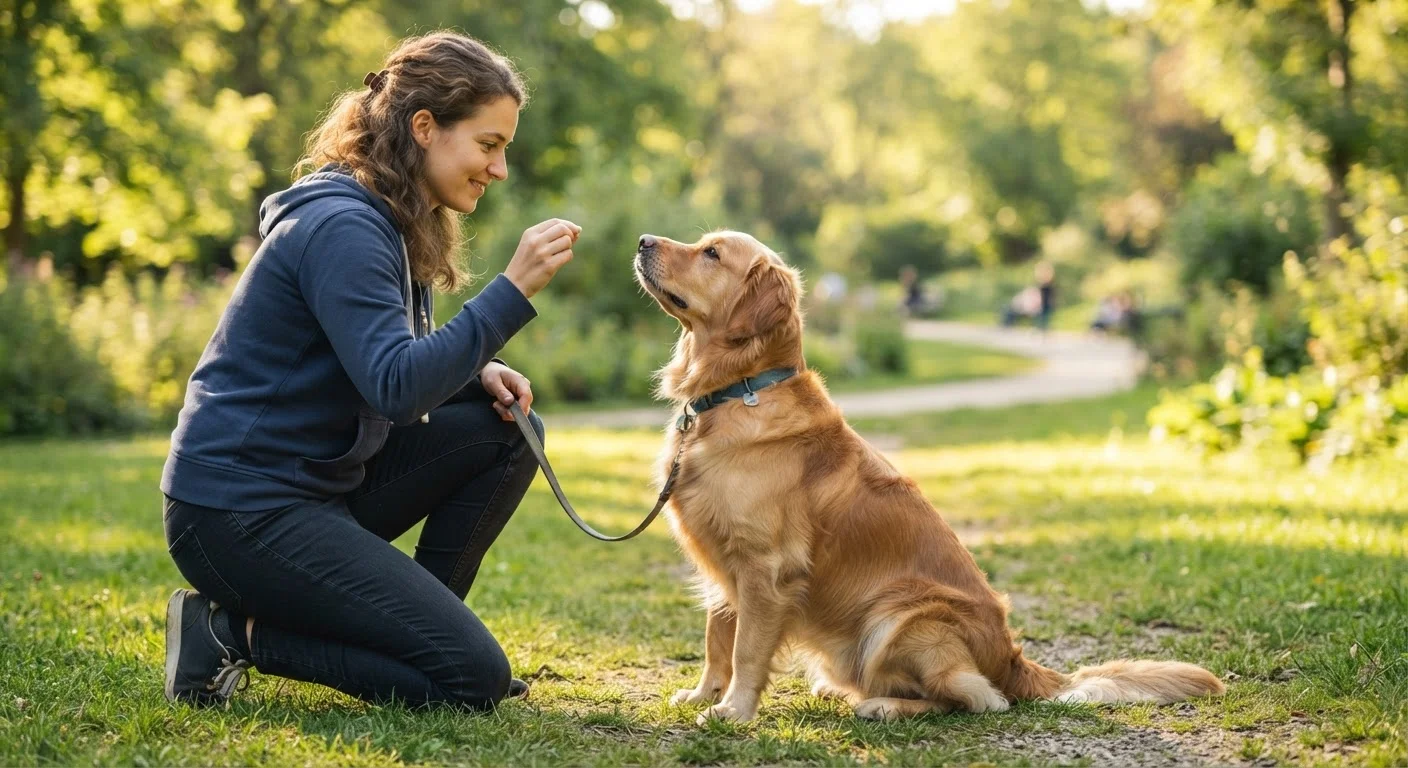
Hold a small treat close to your dog's nose, then slowly move your hand upward. As the dog's nose follows the treat, their rear will naturally lower toward the ground. The moment their bottom touches the floor, say "sit" in a calm, clear voice and immediately give the treat.
Repeat this sequence five to eight times per session. Within a few sessions, most dogs begin to sit when they hear the word alone, before you raise your hand.
Add a hand signal for sit
Once your dog sits reliably on the verbal cue, pair it with a hand signal: a palm facing upward, moving upward from your hip. Using both a verbal and visual cue gives your dog two ways to understand the request, which is useful in noisy environments or at a distance.
Teach stay
Ask your dog to sit. Open your palm toward them like a stop sign and say "stay." Take one small step back, then immediately step forward and reward. Duration and distance both come later; the first goal is that your dog holds position for even two seconds.
Gradually increase the time between the cue and the reward, adding one or two seconds per session. Once your dog stays for ten seconds with you directly in front, begin adding small steps of distance.
Teach come
Attach a long line to your dog's harness or collar. Crouch down, open your arms, and say your dog's name followed by "come" in an upbeat tone. When your dog reaches you, reward generously with treats and praise. The recall should always feel like the best thing that happened to your dog all day.
Practice come in a low-distraction environment first. Gradually work in areas with more activity once the response is consistent at home.
Practice in new environments
Once your dog responds well in a quiet room, move practice outside or to a slightly busier area. Dogs do not generalize commands automatically; a dog who sits reliably in the kitchen may need several repetitions to understand that "sit" means the same thing at the park.
Keep sessions short and expectations modest when entering a new environment. Reward more generously in distracting settings to help your dog learn that listening is worth it even when other things compete for their attention.
If your dog struggles with any step, go back one step rather than pushing forward. Progress that is slightly slower is more durable than progress that cracks under mild distraction.
Fitting training into daily life
You do not need a formal training session every time you work on these commands. Ask your dog to sit before placing their food bowl down, or practice a brief stay while you put on your shoes. These small repetitions throughout the day add up quickly.
Dogs that learn sit, stay, and come as part of normal household routines tend to respond more reliably in real-world situations than dogs who only practice during dedicated training time. Once your dog has a solid recall and can hold a stay for thirty seconds or more, you have a good foundation for addressing more complex behavior. The guide to building a calmer daily routine explains how to structure your dog's day so that training and enrichment work together. For owners also working on confinement and independence skills, crate training guidance pairs well with the commands covered here.