

| Behavior category | Possessive aggression |
| First warning signals | Stiffening, whale eye, faster eating |
| Common triggers | Food bowls, chews, toys, resting spots |
| Who is at highest risk | Young children and other household pets |
| Recommended specialist | Veterinary behaviorist or certified applied animal behaviorist |
| Why punishment backfires | Removes the warning growl without changing the underlying emotion |
What resource guarding actually is
Resource guarding is a dog's attempt to control access to something it values: food, toys, a resting spot, or even a person. The behavior is rooted in normal canine survival instincts. In a dog's world, holding onto something valuable makes sense. The problem is that these instincts can produce dangerous behavior inside a household, especially when children or other pets are involved.
Most owners notice resource guarding only after a dog growls loudly or snaps. By that point, the behavior has already been practiced and reinforced many times. Dogs rarely go from calm to aggressive without passing through earlier, quieter signals first.
Resource guarding
A behavior pattern in which a dog uses threat signals or aggression to keep other animals or people away from something it values. The valued item can be food, toys, spaces, or even people.
Whale eye
A visual stress signal in which the whites (sclera) of a dog's eyes become visible, usually because the dog is turning its head away while keeping its gaze fixed on a person or animal. It indicates tension and is often a precursor to more overt warning behaviors.
Desensitization
A behavior modification technique that gradually exposes a dog to a trigger at low enough intensity to avoid a fear or guarding response, then slowly increases intensity over many sessions. The goal is to reduce the dog's emotional reaction to the trigger.
Counterconditioning
A process that pairs a trigger the dog finds threatening with something it finds very pleasant, such as a high-value food treat. Over time, the dog's emotional response to the trigger changes from negative to neutral or positive.
Threshold
The point at which a dog's stress or arousal level becomes high enough to produce a reactive behavior such as growling, lunging, or snapping. Keeping a dog below threshold during training allows learning to occur.
Early signals most owners overlook
The signals below appear well before growling and are easy to misread or dismiss entirely.
Stiffening and freezing
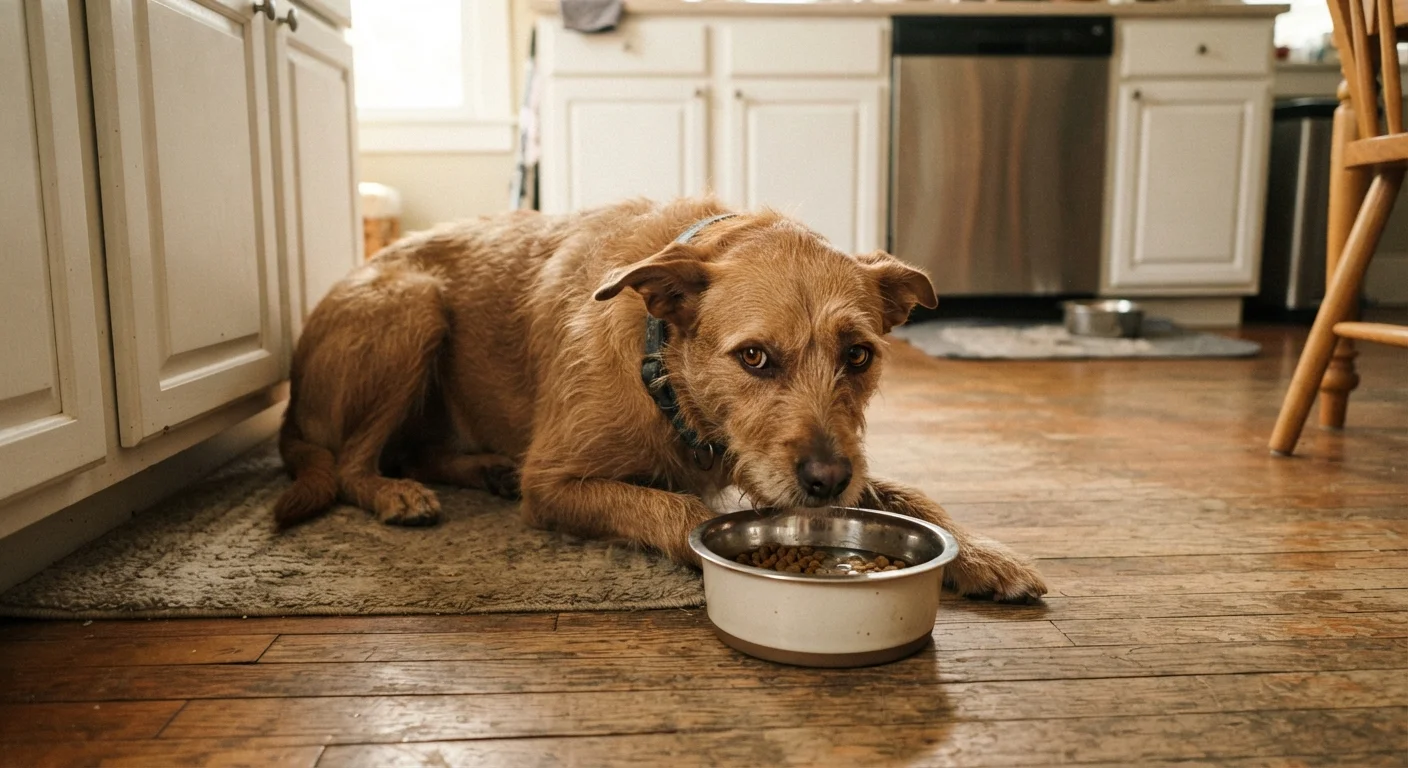
When a dog goes still over its bowl or a chew, that freeze is communication. The body becomes rigid, movement stops, and the dog often holds its breath momentarily. Many owners interpret this as the dog simply being focused on eating. It is actually a warning to back away.
Eating faster when someone approaches
A dog that suddenly accelerates its eating as a person or animal walks nearby is signaling discomfort. The dog is trying to consume the resource before a perceived threat can take it. Speed-eating is one of the earliest measurable changes in behavior around food.
Side-eye or whale eye
Watch for the whites of the eyes becoming visible as the dog turns its head slightly away from the resource while keeping its gaze on the approaching person. This expression, sometimes called whale eye, is a stress signal that precedes more overt warning behaviors.
Hard stare
A sustained, unblinking stare directed at anyone who comes close is a clear tension signal. Unlike normal eye contact, this stare is fixed and lacks the soft blinking that relaxed dogs show.
Low body posture over the item
A dog may lower its head and neck to hover directly over a toy or bowl, using its body as a physical shield. This is sometimes paired with a slight lip curl that owners miss because they are not watching closely.
| Behavior category | Possessive aggression |
| First warning signals | Stiffening, whale eye, faster eating |
| Common triggers | Food bowls, chews, toys, resting spots |
| Who is at highest risk | Young children and other household pets |
| Recommended specialist | Veterinary behaviorist or certified applied animal behaviorist |
| Why punishment backfires | Removes the warning growl without changing the underlying emotion |
Why these signals get missed
Several factors make early guarding signals easy to overlook. Small dogs are often picked up rather than observed, so subtle posture changes go unseen. Dogs with floppy ears or heavy facial folds may show lip curls or tension that are harder to read than in dogs with expressive, uncovered faces. Owners who are used to a dog that has never bitten often assume the dog never will, which reduces attentiveness to warning signs.
Social context matters too. When a dog guards from another dog rather than a person, owners sometimes frame it as the dogs "working out their hierarchy" and do not intervene. Resource guarding between dogs carries its own risks and warrants the same careful attention.
Understanding cat aggression follows a similar principle: animals signal discomfort long before behavior escalates. Reading those earlier signals is what prevents most bites, scratches, and confrontations.
What to do when you spot these signals
The immediate step is simple: do not test the dog by reaching toward the resource. That approach can push the dog past its threshold and result in a bite. Instead, create distance. Walk away calmly and give the dog space to finish with the item.
From there, the goal is to change how the dog feels about people approaching its valued items. A qualified veterinary behaviorist or a certified applied animal behaviorist can guide a structured behavior modification program, typically involving desensitization and counterconditioning. These methods involve approaching at a non-threatening distance and pairing that approach with something the dog values highly, so the dog learns that a person coming close predicts something good.
Management measures help in the meantime. Feed dogs separately if guarding happens between pets. Pick up high-value items when guests visit. Keep young children away from the dog while it has food or chews. These steps reduce rehearsal of the behavior while a longer-term plan is in place.
Avoid punishment. Correcting a dog for growling removes the warning without changing the emotional state driving the behavior. A dog that has been punished for growling may skip the warning entirely and bite without prior signals.
This article is for informational purposes only and does not substitute for professional veterinary or behavioral advice. If resource guarding in your dog poses a safety concern, consult a licensed veterinary behaviorist or certified applied animal behaviorist.