

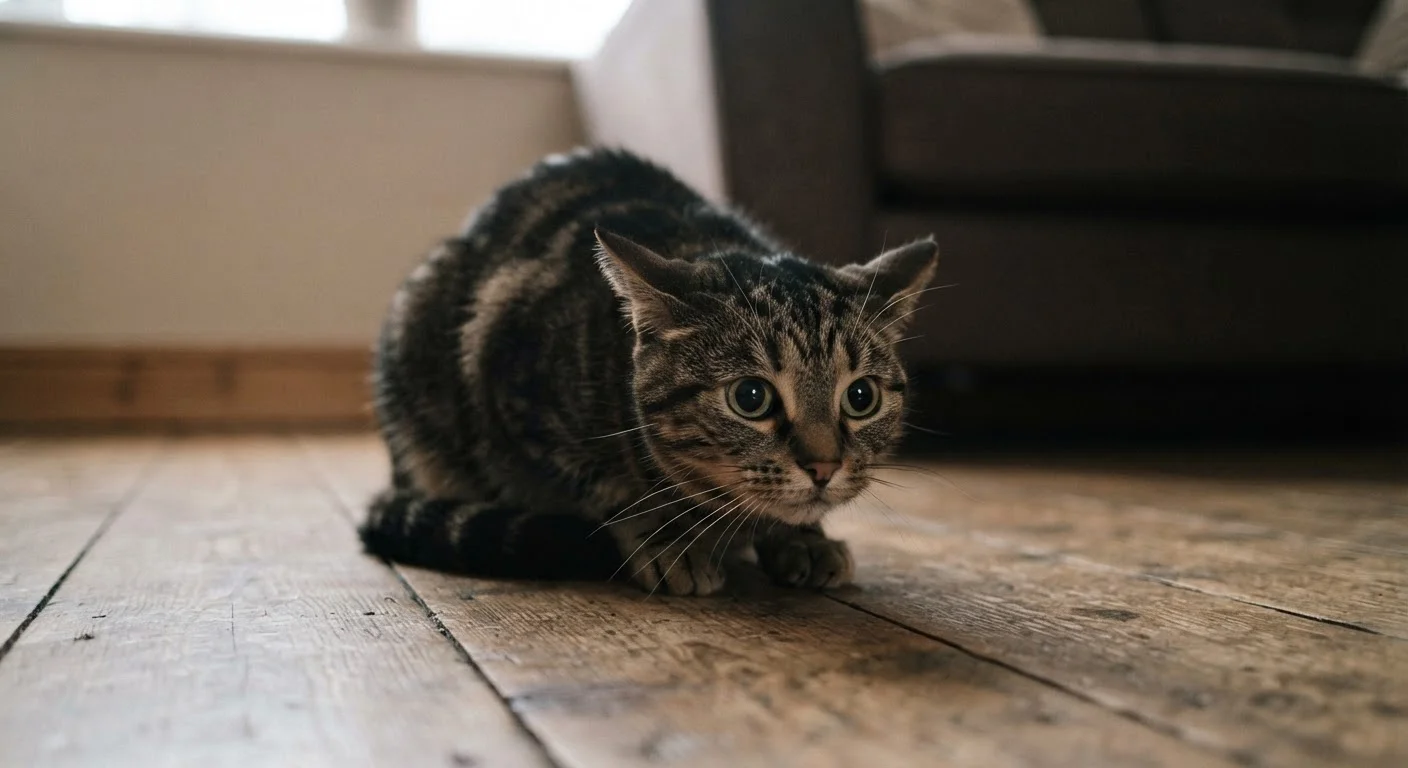
Key Takeaways
- Cats signal discomfort through posture and body language before resorting to scratching or biting.
- Flattened ears, dilated pupils, and a tucked or lashing tail are reliable early warning signs.
- Petting-induced aggression is common and stems from sensory overstimulation, not meanness.
- Pain can trigger sudden aggression in cats that were previously gentle and tolerant.
- Responding calmly to early signals, rather than pushing past them, reduces escalation significantly.
Cat aggression toward people
Cat aggression toward people describes any behavior a cat uses to threaten or physically harm a human, including hissing, swatting, scratching, and biting. In most cases it is a response to an internal state, such as fear, pain, overstimulation, or redirected excitement, rather than random hostility. Cats almost always send warning signals before aggression escalates, and those signals appear in their posture, ears, tail, and eyes.
Veterinary behaviorists classify feline aggression into several types, including fear-based, pain-induced, play, redirected, and petting-induced aggression. Each type has a distinct set of triggers and body language precursors.
Why cats don't just 'snap'
A common belief is that cats attack without warning. In practice, cats are rarely silent about their discomfort. They communicate steadily through body posture, facial expression, and movement, and most escalations follow a sequence of signals that went unnoticed or were ignored.
Understanding that sequence changes how you respond. When you can read what a cat is saying five seconds before a bite, you can stop the interaction before anyone gets hurt. That skill also helps owners stop feeling like their cat is unpredictable, because the behavior almost always makes sense once you know what to look for.
For context on how unresolved stress affects cats physically over time, see how chronic stress affects pets' physical health.
The body language progression before aggression
Cat aggression body language moves through recognizable stages. Early signals are subtle; later signals are unmistakable. Learning to catch the early ones is where most progress happens.
Early warning signals
- Ears rotating back or flattening sideways
- Pupils dilating even in normal light
- Tail tip beginning to flick or twitch
- Skin along the back rippling or twitching
- Body lowering or becoming very still
Mid-level signals
- Ears fully flattened against the head
- Head turning away or chin tucking
- Tail wrapping tightly around the body or lashing quickly
- A low, quiet vocalization or growl
Escalated signals
- Hissing or spitting
- Paw raised with claws extended
- Body arched sideways to appear larger
- A direct, unblinking stare
Each stage is a request for space. When earlier signals are missed, cats move to the next level because they have no other option.
Watch the tail, not just the face
Owners often focus on a cat's face for signs of mood, but the tail is frequently the first part of the body to show agitation. A rapidly lashing or thumping tail during petting is a reliable cue to stop, even if the cat's face looks relaxed. Building the habit of watching the whole body, not just the eyes, gives you more time to respond before a bite occurs.
Common types of aggression and their triggers
Knowing what kind of aggression you are seeing helps you respond appropriately rather than making the situation worse.
Petting-induced aggression
This is one of the most frequently reported forms. A cat that seemed to be enjoying being petted suddenly bites or swats. The cat was not being deceptive. Repeated physical contact can cross a sensory threshold, and the bite is the cat's way of saying it reached its limit. Skin rippling and tail flicking are the last clear warnings before this type of bite happens.
Fear-based aggression
A cat that feels cornered or cannot escape a perceived threat will often attack as a last resort. This is defensive, not predatory. The cat's body will typically look small and compressed, not confident and forward-leaning. Giving the cat an exit route usually stops this pattern before it escalates.
Redirected aggression
When a cat becomes highly aroused by something it cannot reach, such as a bird outside a window or another cat, it can redirect that arousal toward whoever is nearby. This type can be particularly intense and is sometimes mistaken for unprovoked attack. The cat is not targeting the person deliberately; it is in a state of high excitation with nowhere to send it.
Pain-induced aggression
A cat in pain will often react to touch that would normally be tolerable. If your cat's aggression appears suddenly and is focused around a specific body area, that area may be injured or sore. The signs a cat may be in pain can be subtle, and a veterinary exam is the clearest way to find out what is wrong.
~90%
Cat bites preceded by missed warning signals
Veterinary behavior consultations commonly find that the majority of cat bites to people occur after a sequence of body language cues that went unrecognized by the owner.
Top 3
Most common aggression types in cats
Fear-based, petting-induced, and redirected aggression are consistently identified as the most frequent forms seen in veterinary behavior practice.
How to respond in the moment
When you notice early body language signals, the most effective response is to stop what you are doing and give the cat space. Do not pull away sharply, as sudden movement can trigger a swat. Move slowly and calmly away from the cat, and avoid making direct eye contact, which cats can read as a challenge.
If a cat is already in an escalated state, do not try to pick it up or comfort it. A frightened or overstimulated cat that gets picked up is a cat that bites. Let it move to a quieter area on its own.
For play aggression, redirect the cat's energy toward a toy before the attack happens. Wand toys and puzzle feeders give cats an outlet for predatory instincts that would otherwise land on hands and ankles. Consistent daily play sessions reduce the frequency of this pattern over time.
Cat care basics covers a range of practical strategies for building a calmer home environment for cats.