

Key Takeaways
- Bag serving guides are averages, not precise prescriptions for every individual animal.
- A pet's calorie needs depend on body weight, age, activity level, and reproductive status.
- Treats count toward daily calories and should not be treated as extras outside the total.
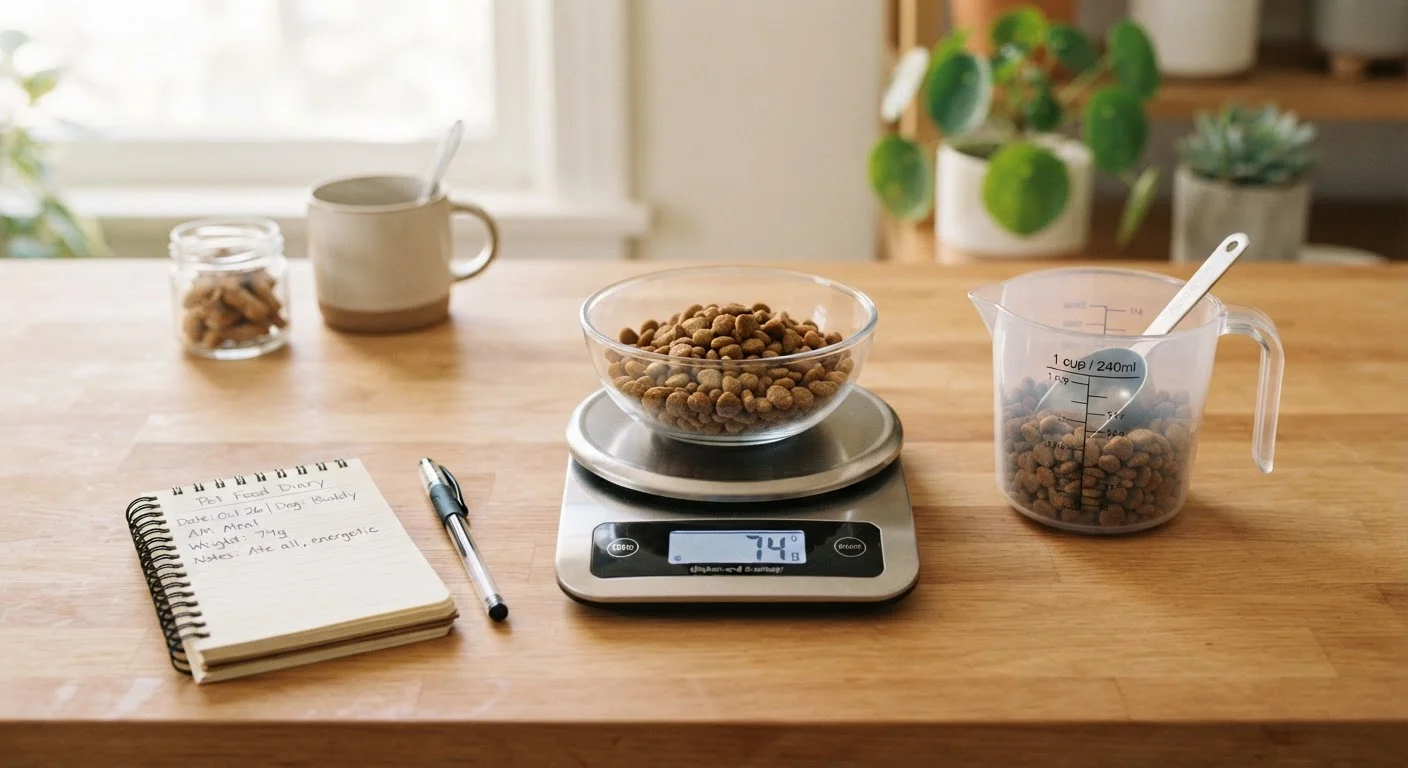
- Weighing food by grams is more accurate than measuring by cup volume.
- Body condition scoring helps you assess whether current portions are appropriate.
Why portions are harder to get right than they look
Pet food bags print serving guides because regulations require them, but those numbers are formulated for an average animal in an average condition. Your pet may need considerably less, or occasionally more, depending on body size, age, neuter status, breed metabolism, and how much physical activity is normal for them.
If you start with the core concepts of pet nutrition already in mind, you will recognize that calorie needs are dynamic, not fixed. A portion that was correct at two years old may be too generous at seven, when a pet's resting metabolism has slowed and activity has decreased. Overfeeding accumulates gradually, which is why weight gain often goes unnoticed until it is significant. Weight creep from serving guide errors is one of the most common feeding problems veterinarians see.
How to estimate the right calorie target for your pet
The starting point is resting energy requirement (RER). For dogs and cats, veterinary nutritionists use the formula: RER (kcal/day) = 70 x (body weight in kg)0.75. A simpler linear approximation works for animals between 2 and 45 kg: RER = (30 x body weight in kg) + 70.
From RER, multiply by a life-stage factor to get the daily energy requirement (DER). Common multipliers include 1.6 for intact adult dogs, 1.4 for neutered adult dogs, 1.2 for weight-loss goals in overweight dogs, and 2.0 or higher for late-stage pregnancy and lactation. Cat multipliers follow a similar pattern. Your veterinarian can confirm the appropriate factor for your specific animal.
Calorie counts vary by food type
Wet food, dry kibble, raw diets, and semi-moist foods all have different caloric densities per gram. A cup of one kibble brand may contain significantly more or fewer calories than a cup of another. Always check the kilocalories per kilogram listed on the product's nutritional panel or contact the manufacturer directly, since this figure is not always printed on the label.
Once you have a DER in kilocalories, divide that number by the food's caloric density (kcal per gram) to find the daily gram weight to feed. This is the figure you measure on a scale, not an approximation from a scoop.
Best practices for accurate, consistent feeding
Calculate your pet's resting energy requirement before adjusting portions
Resting energy requirement (RER) is the baseline number of calories an animal needs at rest to maintain basic body functions. Multiplying RER by a life-stage factor gives a daily energy requirement (DER) that accounts for activity, age, and reproductive status. Without this calculation, portion decisions are guesswork.
Weigh food in grams rather than measuring by cup volume
Cup measurements vary depending on how tightly kibble is packed, the shape of individual pieces, and whether the cup is leveled. A difference of 20 to 30 percent between a loosely filled and a well-packed cup is common, which adds up to meaningful calorie surplus over weeks.
Include treats in the daily calorie budget
Treats are food. Many owners track meals carefully but treat as a separate, uncounted category, which creates consistent daily overfeeding. High-value training treats in particular are calorie-dense relative to their size.
Use body condition scoring to validate your portion calculations
Calorie math gives a starting estimate, but individual metabolism varies. Body condition scoring (BCS), a 9-point scale used by veterinarians, provides a physical check on whether calculated portions are producing the intended result.
Adjust portions when a pet's life stage or activity level changes
The DER multiplier for a lactating dog is roughly twice that of a spayed adult at rest. Seasonal activity changes, recovery from illness, and the transition from puppyhood to adulthood all shift calorie needs substantially. A single portion set years ago may no longer fit the animal's current state.
Cats in multi-pet households present a specific challenge: if food is left out freely, dominant animals often consume a disproportionate share. Separate feeding stations or scheduled, supervised meals make individual portion control possible. For dogs prone to eating quickly, portion division across two or three meals per day can also support digestive health.
Putting it into practice
Body condition assessment is the feedback loop that tells you whether your calculations are working. If your pet scores above 5 on a 9-point scale after several weeks at the calculated DER, reduce the daily portion by 10 percent and reassess in three to four weeks. Small, consistent adjustments avoid the metabolic stress of sudden restriction.
Dogs and cats are not the only animals where this matters. Birds, rabbits, and small mammals also have documented calorie requirements that vary by species and size. The underlying principle is the same: start with an estimated energy target, measure accurately, account for all food sources including treats and supplements, and adjust based on physical condition over time. For cat-specific feeding guidance, the cat care basics hub covers additional detail on life-stage feeding decisions.
This article is for informational purposes only and is not a substitute for professional veterinary advice. Consult your veterinarian before making significant changes to your pet's diet, particularly if your pet has an existing health condition.