

Key Takeaways
- Separating the new cat in a dedicated room for the first week reduces territorial conflict.
- Scent swapping before any face-to-face contact is the single most effective preparation step.
- Rushed introductions are the most common reason cat pairings fail long term.
- Each cat needs its own food bowl, water source, and litter box, plus one extra litter box.
- Stress signs such as hiding, hissing, or appetite loss are normal early on but should resolve within weeks.
What you will need
Why cats need a phased introduction
Cats are territorial by nature. A resident cat has mapped your home as its own space over months or years. Placing a second cat into that space without preparation reads, to your resident cat, as an intrusion. The stress response that follows is not aggression for its own sake; it is a normal reaction to a perceived threat to resources and security.
A phased approach works by giving each cat time to process the newcomer incrementally. Scent comes first, then sound, then sight, then contact. Each stage lets both animals adjust before the next demand is placed on them. Skipping stages is the most common cause of failed multi-cat households. For broader context on managing feline behavior, the Pet Behavior Tips hub covers stress signals across many situations.
What you will need
What to prepare before the new cat arrives
Duplicate your supplies before bringing the second cat home. The general rule is one resource per cat, plus one extra. For two cats, that means three litter boxes placed in different locations, not side by side. Each cat should have its own food station so that neither has to pass the other to eat. If you need a broader checklist of setup essentials, the first cat setup guide covers the full range of supplies and space preparation.
Vertical space also matters. Shelves, cat trees, or window perches allow a lower-status cat to escape without leaving the room. Cats that can increase physical distance without fleeing entirely are less likely to develop chronic stress.
How to follow the introduction steps
Set up a separate base room for the new cat
Before the new cat arrives, prepare a single room with everything it needs: food, water, a litter box, a scratching surface, and a hiding spot such as a box or covered bed. Keep this room off-limits to your resident cat. The new cat will spend its first days here, and the physical barrier lets both animals begin processing each other's presence through scent alone, without any visual confrontation.
Let both cats settle before any interaction
For the first two to three days, do not attempt contact between the cats. Spend time in the base room with the new cat so it associates you with safety. Your resident cat will detect the newcomer's scent under the door; this is normal and expected. Watch both animals for appetite changes, litter box use, and sleep patterns, all of which signal how well each cat is coping.
Swap scents deliberately
Take a soft cloth and gently rub it along the new cat's cheeks and chin, then place it near your resident cat's sleeping area. Do the same in reverse. After a day, you can swap bedding between the two spaces. This process lets each cat form a scent memory of the other at their own pace. Pair the scent introduction with something positive, such as a small treat, so the association stays neutral or pleasant.
Introduce scent through a shared barrier
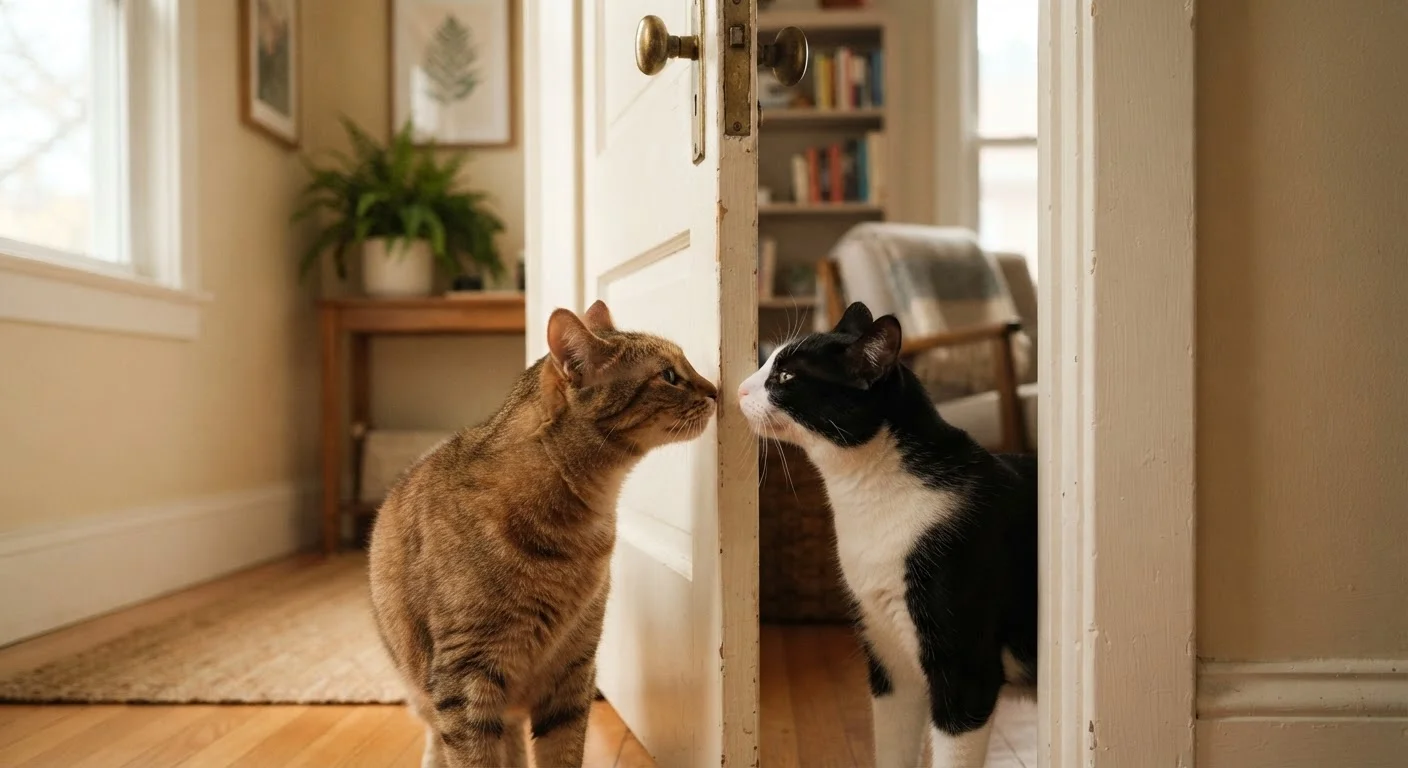
Once neither cat shows sustained agitation at the door (no constant growling or pacing), place their food bowls on opposite sides of the closed door. Over several days, move the bowls progressively closer to the door. The goal is for both cats to eat calmly within a foot or two of each other with only a door between them. This step may take several days or up to two weeks depending on each cat's temperament.
Allow brief, supervised visual contact
Crack the door open one to two inches, or use a baby gate, so the cats can see and smell each other without direct access. Keep sessions short, around five to ten minutes. Watch for relaxed body posture, slow blinking, or simple curiosity. Hissing at distance is common and does not mean the introduction has failed. End the session before either cat escalates to sustained growling or swatting.
Open the door and allow free exploration
When both cats remain calm during visual sessions over multiple days, open the door fully and let the new cat explore the shared space at its own pace. Do not force proximity. Keep multiple exit routes clear so neither cat can corner the other. Supervise all interactions for the first week of free access. Separate them again at night or when you cannot watch until you are confident the dynamic is stable.
The timeline across these steps varies. A confident, social cat may progress in two weeks. A shy or previously single cat may need six to eight weeks at earlier stages before it is ready to share space without conflict. Follow each cat's signals rather than a fixed calendar.
Food is a useful gauge throughout. If either cat refuses meals for more than a day or two at any stage, slow down. Appetite return is a reliable sign that a cat's stress level has dropped enough to move forward. You can find guidance on diet adjustments during stressful transitions in the article on switching pet food safely, which includes strategies for cats that go off food during changes.
What normal friction looks like, and what to watch for
Some hissing, swatting, and chasing in the first weeks of free cohabitation is expected. Cats establish social order, and that process is not always quiet. Watch for escalation patterns rather than isolated incidents: repeated ambushes, one cat consistently unable to access food or the litter box, or either cat spending most of its time hiding.
Chronic stress in cats can show up as over-grooming, inappropriate elimination, or compulsive behaviors. If these appear after four or more weeks of cohabitation, a veterinary consultation is worthwhile to rule out underlying health issues and discuss whether a behavioral assessment is appropriate.
This article is for informational purposes only and is not a substitute for professional veterinary advice.